
 eSIM Studios
Why you can trust Tom's Hardware Our expert reviewers spend hours testing and comparing products and services so you can choose the best for you. Find out more about how we test.
Cooler Master was founded in 1992 and is headquartered in Taipei, Taiwan, producing computer cases, power supplies, CPU coolers, and peripherals. The company started with CPU coolers, then introduced the world's first side-window computer case in 1995, the first modular power supply in 2000, and the first heat pipe CPU cooler in 2005. Over thirty years, it grew from a thermal solutions specialist into a broadly recognized PC hardware brand with a global distribution network and manufacturing facilities in Huizhou, China. PSUs have been part of that portfolio from early on, though the division has historically attracted less attention than the company's cooling and chassis products.
The MWE series sits at the entry point of Cooler Master's PSU lineup. It has gone through multiple revisions over the years, and the Bronze V2 is a mature iteration designed to be certifiable, reliable, and inexpensive. It is currently being cleared fr om retail shelves to make space for the incoming MWE V4 generation, which has pushed street prices down to ludicrously competitive levels. We take a closer look at the MWE Bronze V2 to see if it belongs among the best power supplies in the market today.
Specifications and DesignSwipe to scroll horizontallyCooler Master MWE Bronze V2 230V 650W Power specifications ( Rated @ 40 °C )RAIL
+3.3V
+5V
+12V
+5Vsb
-12V
MAX OUTPUT
19A
19A
54A
3A
0.3A
Row 1 - Cell 0120W
120W
648W
15W
3.6W
TOTAL
650W
Row 2 - Cell 2 Row 2 - Cell 3 Row 2 - Cell 4 Row 2 - Cell 5AC INPUT
200 - 240 VAC, 50 - 60 Hz
Row 3 - Cell 2 Row 3 - Cell 3 Row 3 - Cell 4 Row 3 - Cell 5MSRP
€ 50
Row 4 - Cell 2 Row 4 - Cell 3 Row 4 - Cell 4 Row 4 - Cell 5Today's best Cooler Master MWE Bronze V2 230V 650W deals
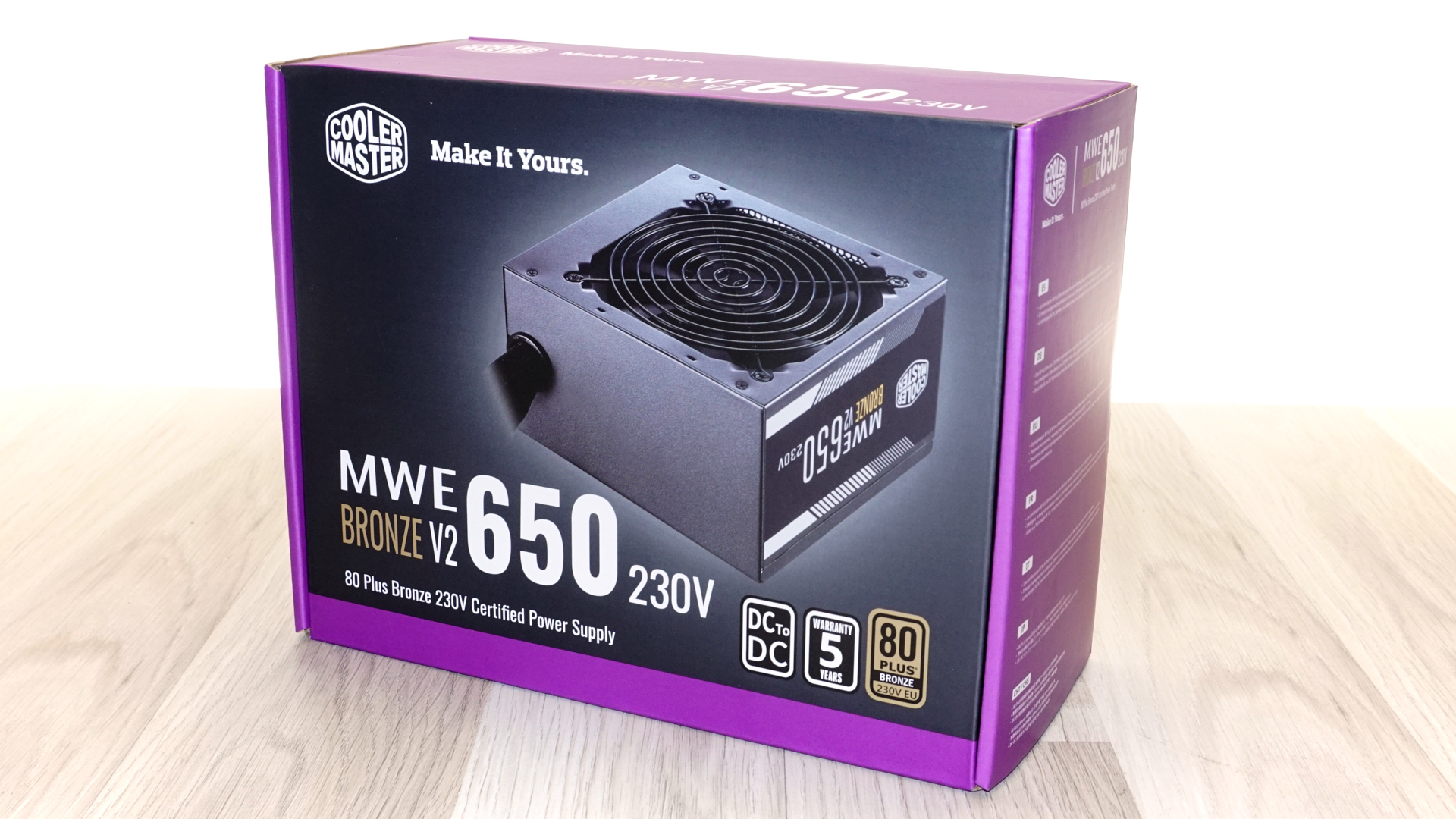
In the BoxThe MWE Bronze V2 ships in a compact cardboard box in Cooler Master's familiar black and purple branding. Protection inside is minimal. The unit sits in a nylon bag with no foam padding, which is not the most reassuring approach.
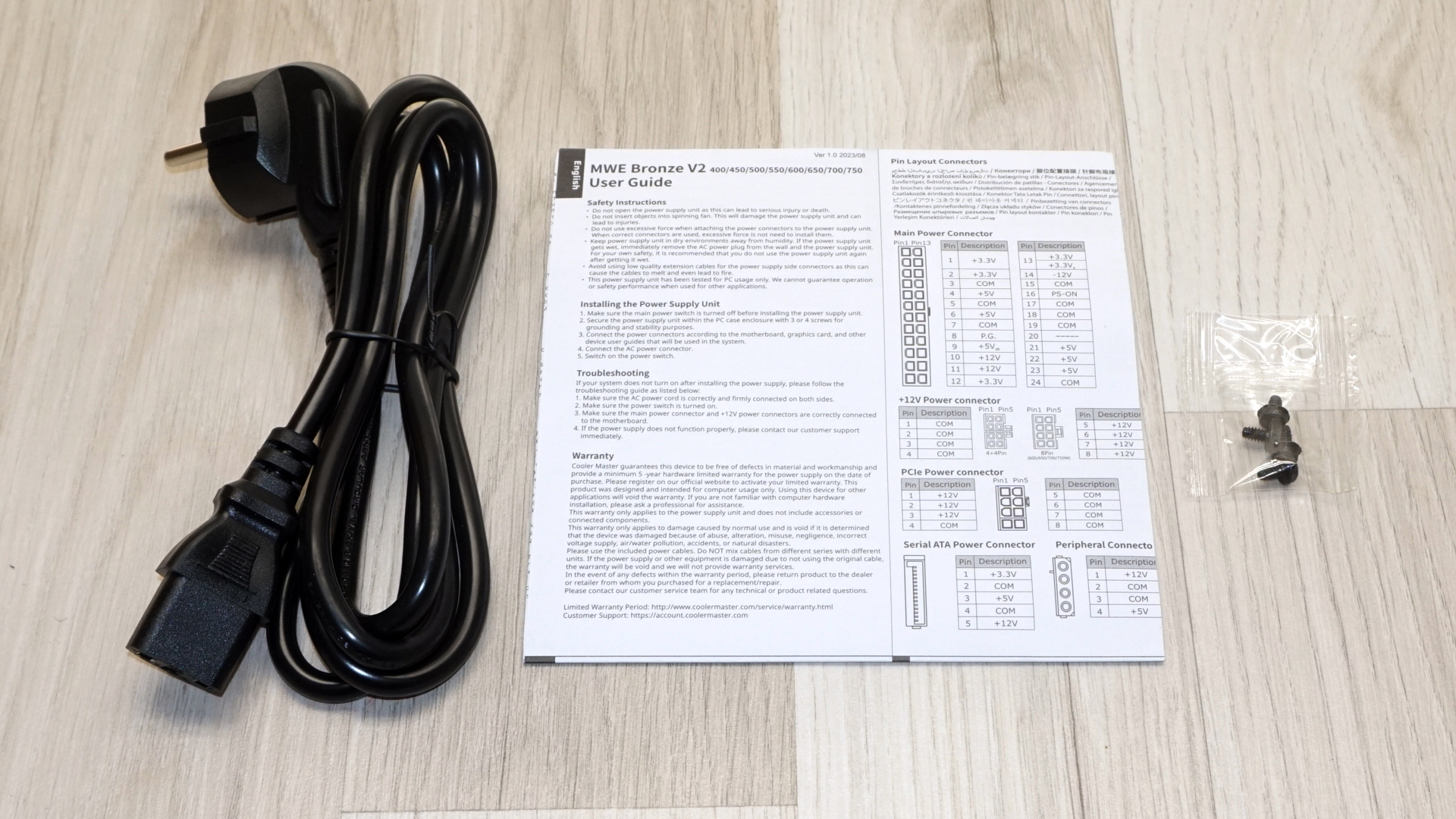
The accessory bundle is stripped down to the bare minimum. Only mounting screws, an AC power cable, and a basic printed leaflet are included. Nothing more. Cable management aids are absent, as is anything beyond the absolute minimum.
The cables are hardwired, which is expected at this price point but worth noting for builders who care about cable routing. On the other hand, the wires are flat and ribbon-like, finished uniformly in black with matching black connectors. The connector count is generous for a 650W unit: four 6+2 pin PCI Express connectors are present, covering dual-GPU light gaming setups or configurations with a single power-hungry card and some headroom. There is no 12V-2x6 connector, which limits compatibility with the newest high-end GPU designs, though that is not really the audience for a unit in this class.
Swipe to scroll horizontallyCooler Master MWE Bronze V2 230V 650WConnector type
Hardwired
Modular
ATX 24 Pin
1
-
EPS 4+4 Pin
1
-
EPS 8 Pin
1
-
PCI-E 5.0
-
-
PCI-E 8 Pin
4
-
SATA
6
-
Molex
3
-
Floppy
-
-
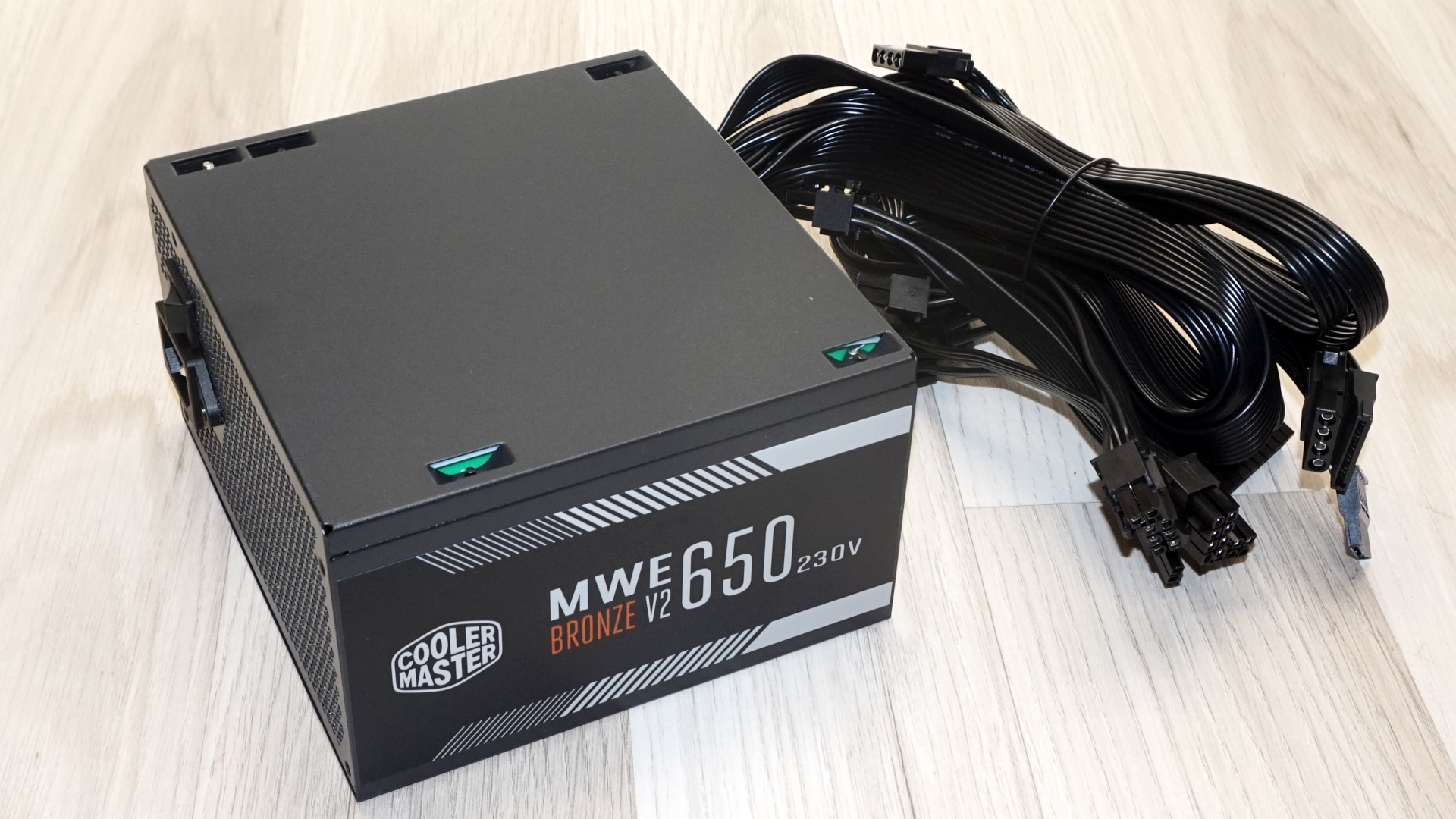
External AppearanceAt exactly 140mm in length, the MWE Bronze V2 conforms to the ATX standard without deviation. It will fit in any ATX-compliant case without compatibility concerns. The chassis is finished in satin black, which looks clean but picks up fingerprints readily. The design is plain. A decorative sticker on the right side is the only visual flourish over what is otherwise a generic enclosure.
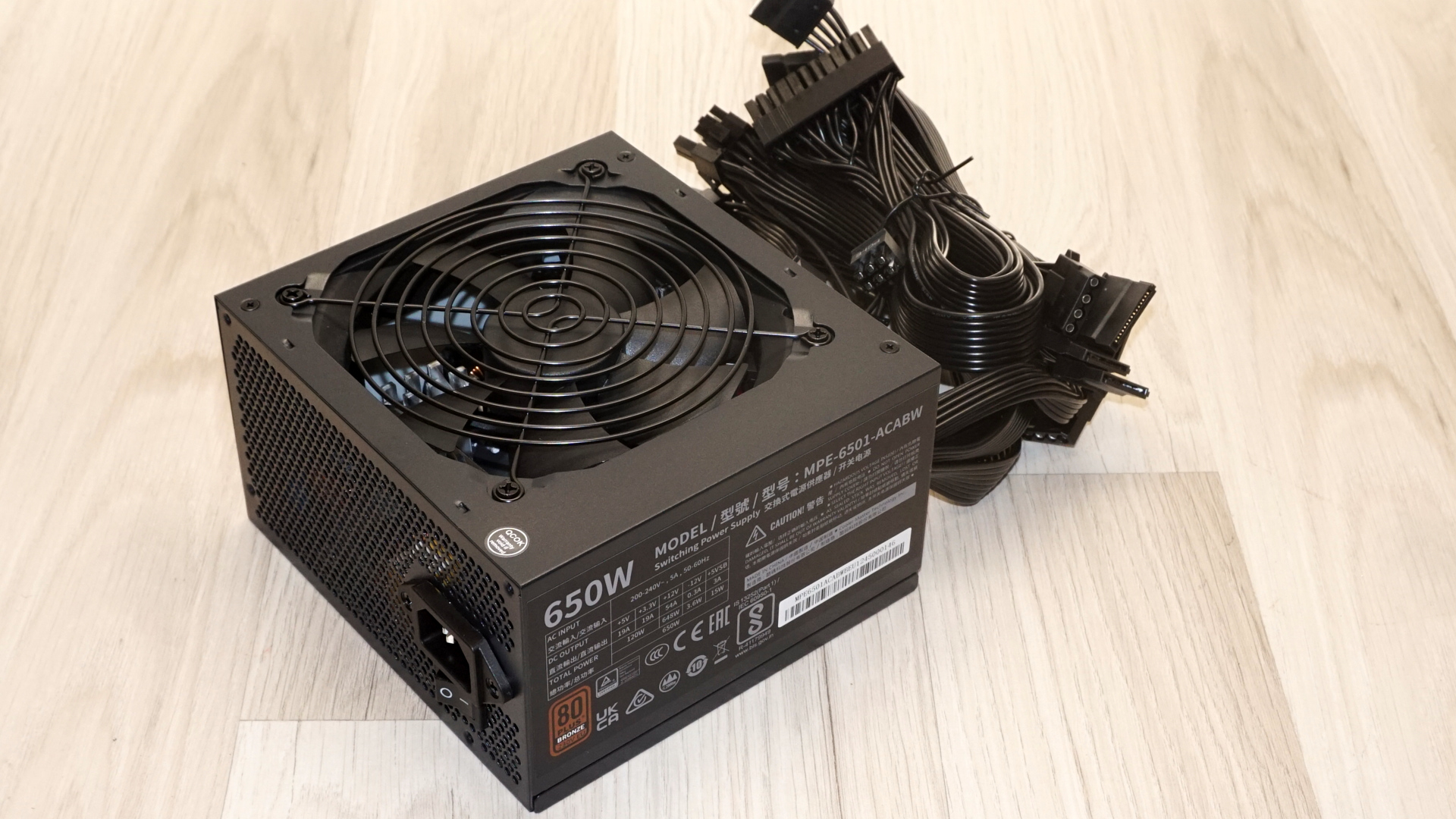
The fan finger guard uses a classic concentric ring design. The left side carries the electrical specification and certification sticker. The front panel holds the standard power switch and AC receptacle. The rear panel is completely bare except for the cable exit point.
Image 1 of 2
(Image credit: Tom's Hardware)(Image credit: Tom's Hardware)One detail on the top panel is unusual - four punched holes serve as mounting points for the internal PCB, a technique more commonly associated with PSU construction from the 1990s than with modern units. It is not a functional issue, but it is a visible indicator of how aggressively the cost envelope has been managed.
Image 1 of 2
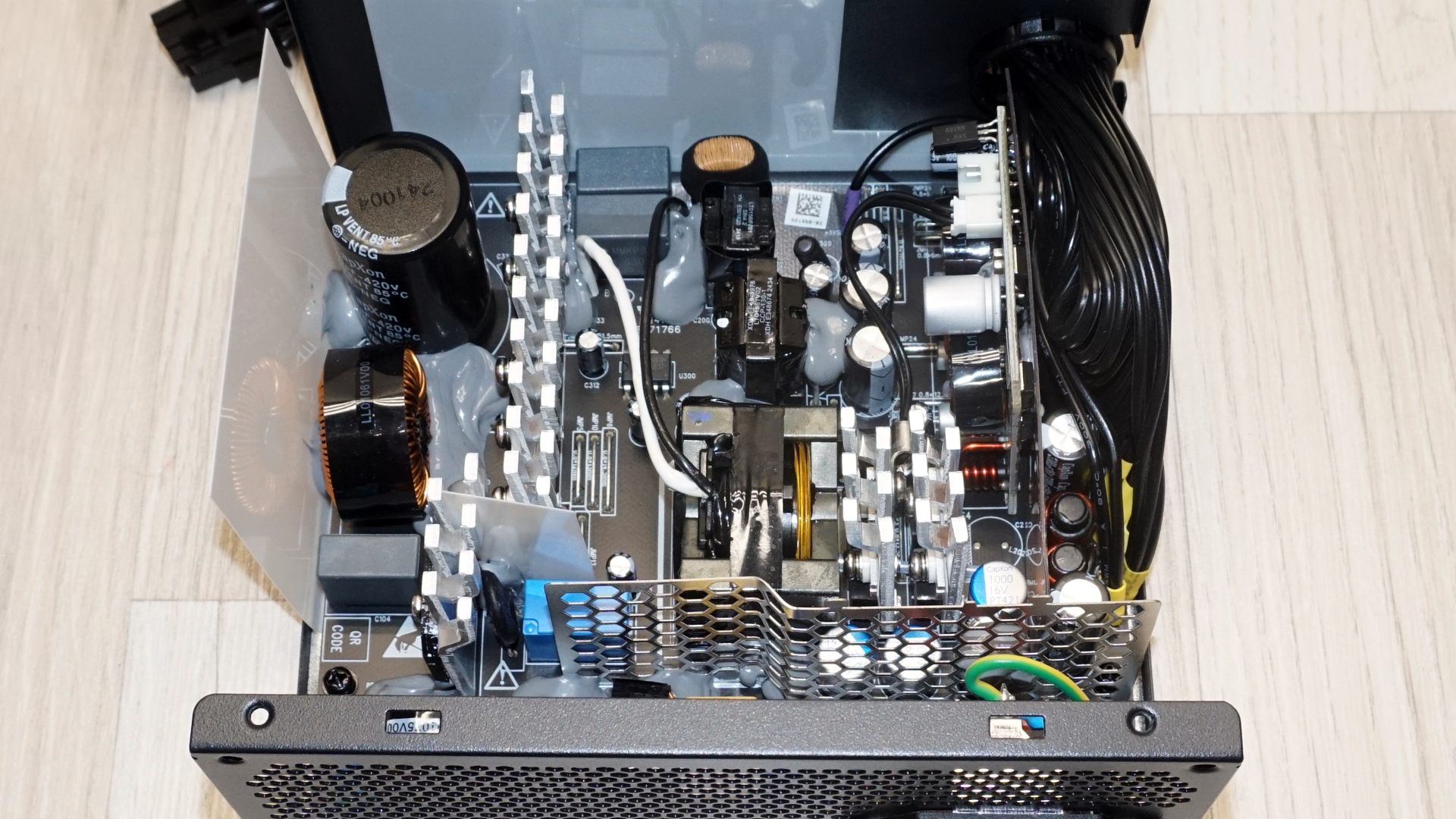
(Image credit: Tom's Hardware)(Image credit: Tom's Hardware)Internal DesignCooling is provided by a Hong Hua HA1225H12F- Z 120mm fan with a fluid dynamic bearing. Fluid dynamic bearings represent a reasonable compromise between longevity and noise at moderate speeds. They are quieter than ball bearings at low RPM and more durable than sleeve bearings under sustained use. The rated maximum speed is 2400 RPM, which is notably high for a 650W unit.
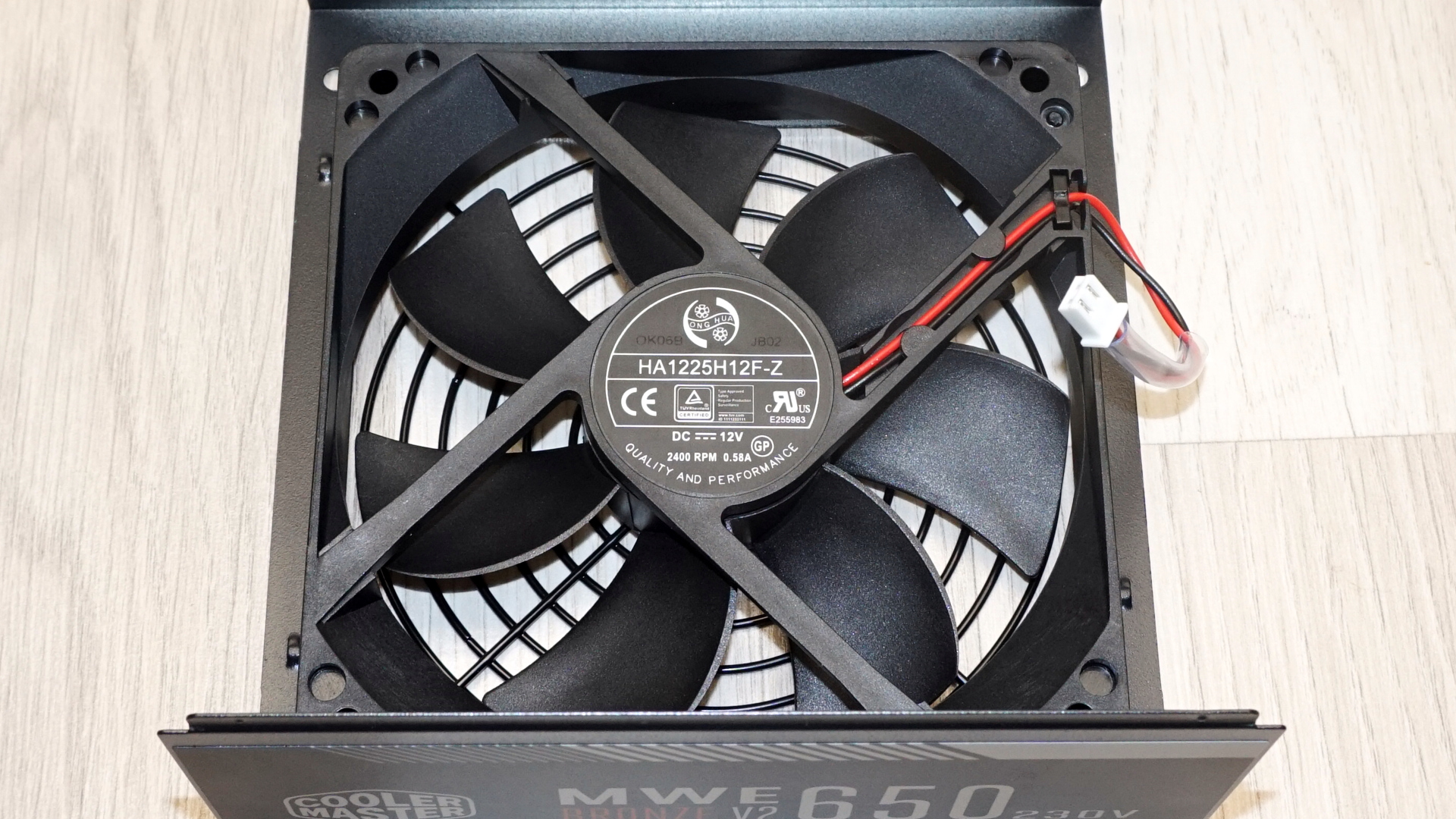
The OEM is Gospower, a Chinese manufacturer operating since 2006. Gospower is a familiar name in budget and mid-tier PSU production, and their platforms have appeared inside products from several recognized brands. Assembly quality here is consistent, even remarkable for such a tier, and the design choices reflect a team that understands what is required.
Image 1 of 2
(Image credit: Tom's Hardware)(Image credit: Tom's Hardware)The input filtering stage is properly equipped with four Y capacitors, two X capacitors, two filtering inductors, and a single rectifying bridge mounted on a basic heatsink. A physical metallic EMI shield is present at the input stage, which is something rarely seen at this price point and speaks to a conscious effort to maintain power cleanliness beyond what the budget strictly demands.
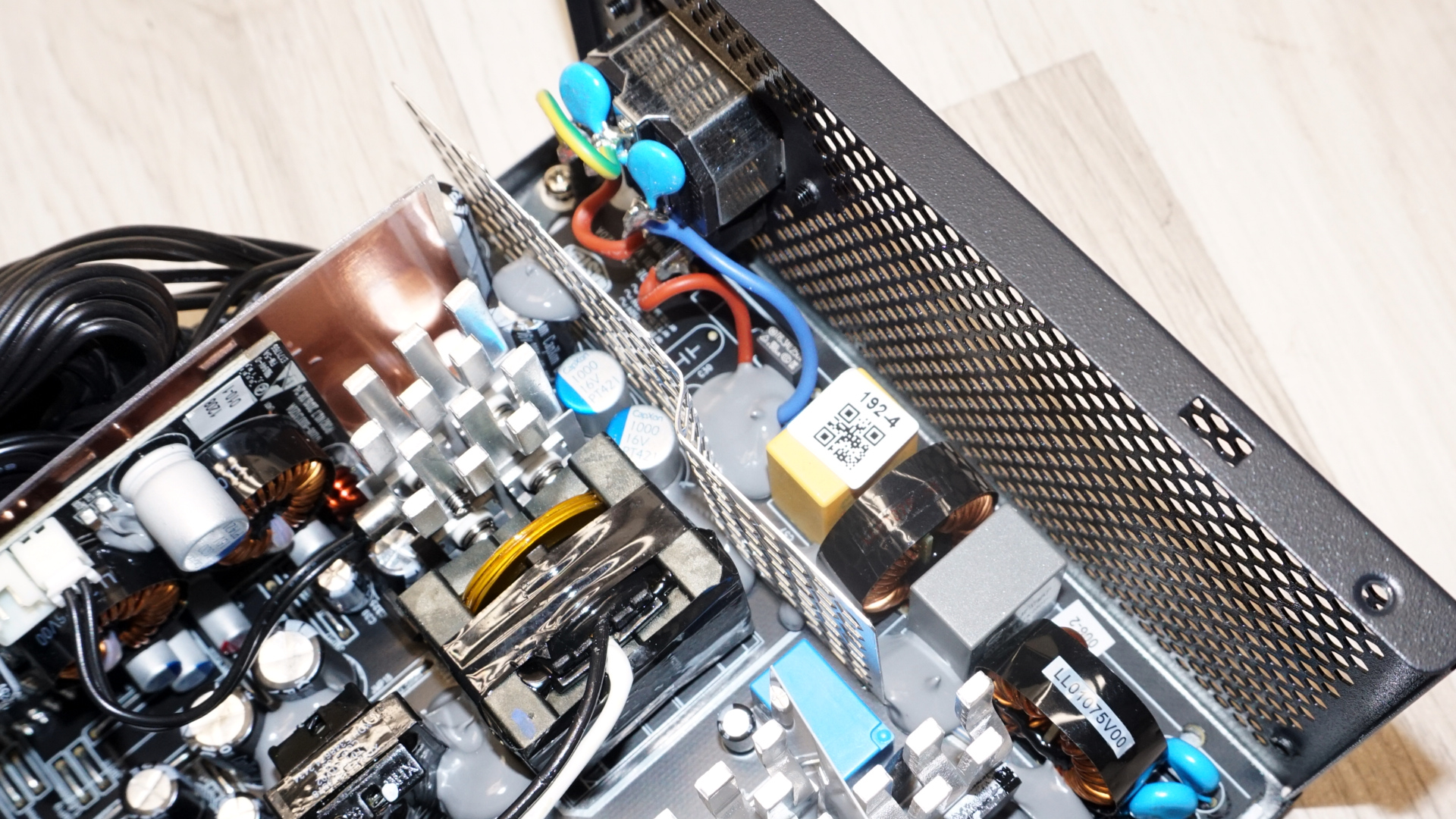
The APFC circuit uses two Jilin Sino-Microelectronics JCS13N50FC MOSFETs and one diode. The passive components include a small taped inductor and a CapXon 470µF bulk capacitor rated at 85°C. CapXon is a reputable manufacturer and their capacitors are generally reliable under normal operating conditions. The 85°C temperature rating is the concern here - it means that sustained high temperatures inside the chassis will noticeably shorten this capacitor's service life, even if the temperature will not reach that mark. For a unit deployed in a well-ventilated case in a temperate room and not heavily loaded most of the time, this is not a serious issue. If the PSU is stressed though, this becomes a liability worth taking seriously.
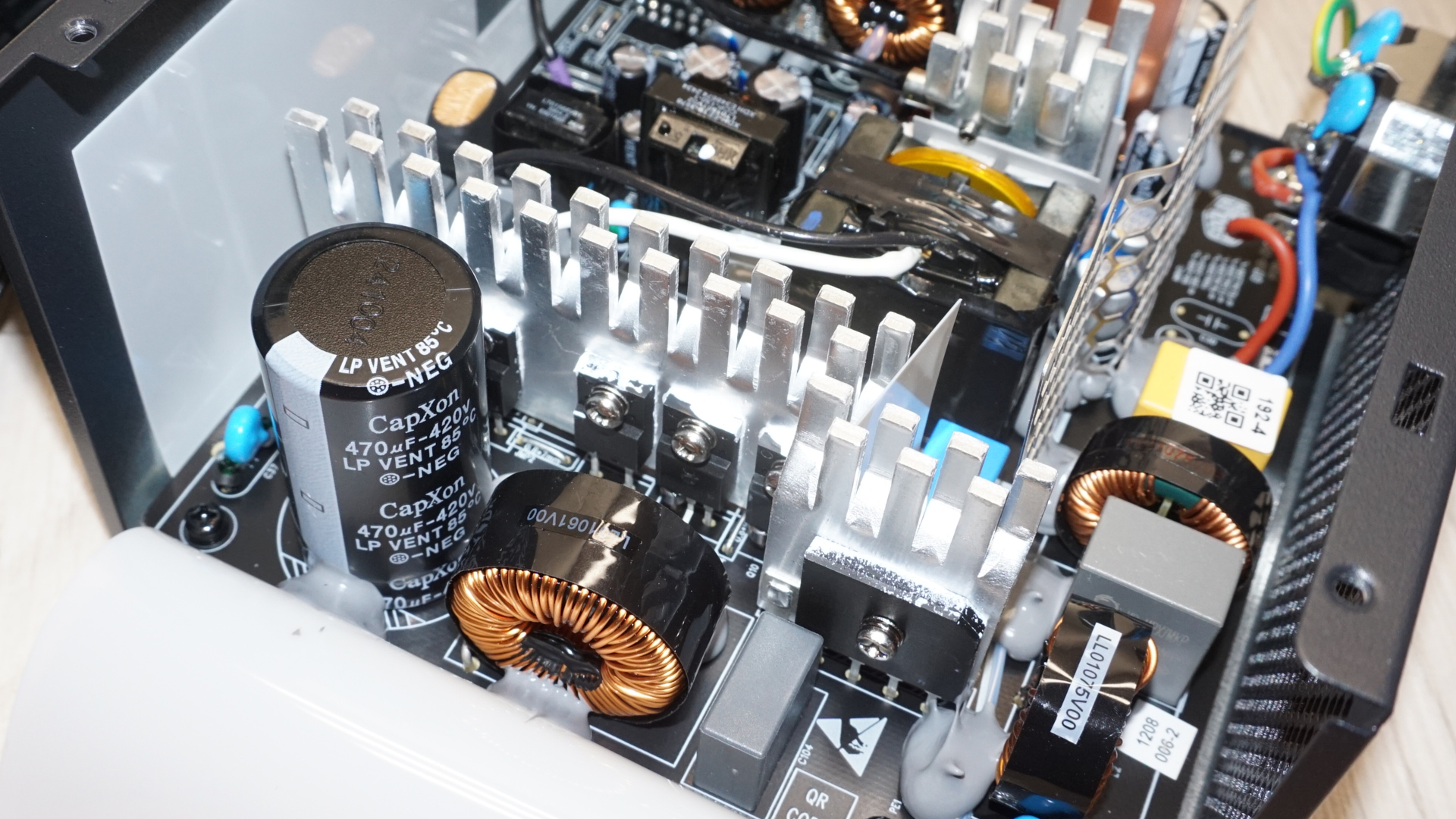
The primary inversion stage employs two Jilin Sino-Microelectronics JCS18N50FH MOSFETs in a full-bridge configuration, sharing a heatsink with the APFC MOSFETs. A half-bridge + LLC topology is nowadays typical for quality PC PSUs. The heatsink itself is rudimentary, but adequate for the power output involved.
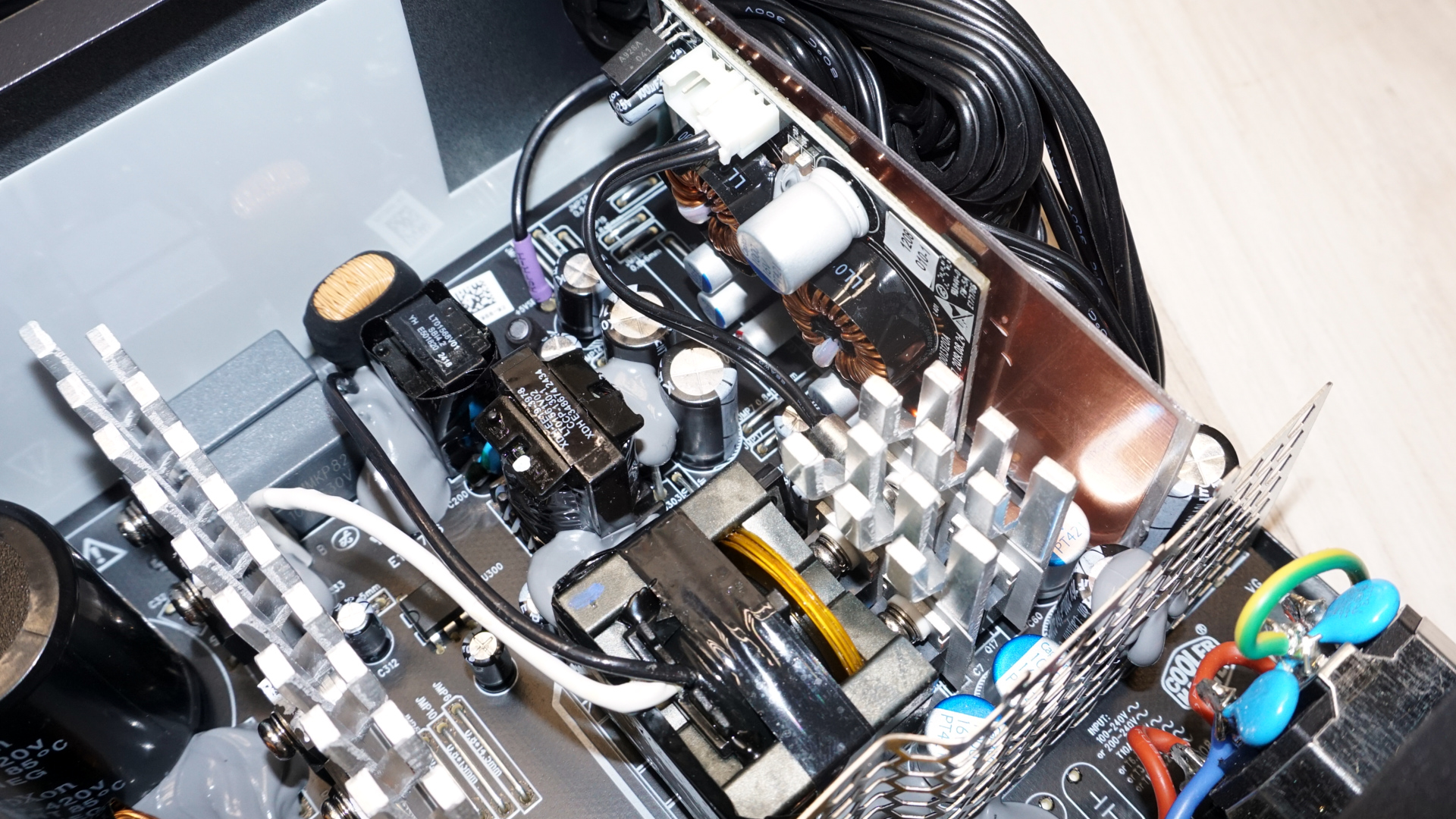
On the secondary side, four NCE Power 40H12 MOSFETs generate the 12V rail through synchronous rectification, mounted on a pair of simple heatsinks. Synchronous rectification replaces the diodes used in older designs with active switches, improving efficiency and reducing heat at the secondary stage. A vertical daughterboard handles DC-to-DC conversion for the 3.3V and 5V rails. A copper strip EMI shield protects the output wiring. Secondary side filtering is handled entirely by CapXon capacitors, electrolytics and polymer alike, with the exception of one unidentified polymer capacitor on the DC-to-DC board.
Cold Test ResultsCold Test Results (25°C Ambient)For the testing of PSUs, we are using high precision electronic loads with a maximum power draw of 2700 Watts, a Rigol DS5042M 40 MHz oscilloscope, an Extech 380803 power analyzer, two high precisio n UNI-T UT-325 digital thermometers, an Extech HD600 SPL meter, a self-designed hotbox and various other bits and parts.
Image 1 of 5
(Image credit: Tom's Hardware)(Image credit: Tom's Hardware)(Image credit: Tom's Hardware)(Image credit: Tom's Hardware)(Image credit: Tom's Hardware)The MWE Bronze V2 meets the 80Plus Bronze certification requirements comfortably on a 230 VAC input. Efficiency across the nominal load range is stable and consistent, averaging at 87.3%, with no significant drops at either end of the load curve. As noted earlier, the 230V certification threshold is more demanding than 115V testing, so the unit's actual performance may be stronger than the Bronze badge suggests when considered in a global context. There are many “Gold” PSUs in the market with similar average efficiency as this one – they have just been certified with an 115 VAC input.
The fan increases speed near-linearly with load and does not cause acoustic concern at low-to-moderate output. At heavy load, it becomes noticeable. Thermal performance is relatively good but nothing to write home about.
Hot Test ResultsHot Test Results (~45°C Ambient)Average efficiency at 230 VAC under elevated ambient conditions reaches 86.3% across the nominal load range. The degradation compared to cold testing is modest, and there are no visible signs of thermal stress at full load, which reflects well on Gospower's thermal design margins.
Image 1 of 5
(Image credit: Tom's Hardware)(Image credit: Tom's Hardware)(Image credit: Tom's Hardware)(Image credit: Tom's Hardware)(Image credit: Tom's Hardware)However, the fan tells a different story - it reaches maximum speed at 70% load and stays there, producing clearly audible noise through to 100% output. Internal temperatures remain relatively controlled up to 50% load. Bey ond that point, the fan is working at its limit and the chassis temperatures rise. The unit was not designed for sustained heavy loading in warm environments, and it does not pretend otherwise.
PSU Quality and Bottom LinePower Supply QualityVoltage regulation is mediocre by current standards. The 12V rail holds to within 2.1%, the 5V rail to 3.4%, and the 3.3V rail to 2.8%. These figures are not alarming for a budget unit but they would be unacceptable in a mid-range or premium product. Ripple suppression is equally unexceptional. The 12V rail peaks at 68mV, the 5V rail at 28mV, and the 3.3V rail at 26mV. All three sit well inside the ATX specification limits of 120mV on the 12V rail and 50mV on the minor rails. For a product in this class, those are fairly good numbers.
During our routine evaluation, we examine the fundamental protection features of all power supply units we review, including Over Current Protection (OCP), O ver Voltage Protection (OVP), Over Power Protection (OPP), and Short Circuit Protection (SCP). Protection circuit behavior is acceptable but quite slack for a unit this stressed. The 3.3V rail triggers OCP at 140% of rated current, the 5V at 146%, and the 12V at 138%. OPP under hot conditions activates at 142% of rated output. These are OK settings for a product designed for gamers and enthusiasts but floppy on a product that will be fighting for its life if stressed that much.
Swipe to scroll horizontallyMain OutputLoad (Watts)
131.59 W
Header Cell - Column 2326.82 W
Header Cell - Column 4483.85 W
Header Cell - Column 6643.53 W
Header Cell - Column 8Load (Percent)
20.24%
Row 0 - Cell 250.28%
Row 0 - Cell 474.44%
Row 0 - Cell 699%
Row 0 - Cell 8 Row 1 - Cell 0Amperes
Volts
Amperes
Volts
Amperes
Volts
Amperes
Volts
3.3 V
1.7
3.35
4.25
3.33
6.37
3.26
8.5
3.25
5 V
1.7
5.07
4.25
5.04
6.37
4.92
8.5
4.91
12 V
9.66
12.14
24.15
12.06
36.22
11.92
48.29
11.89
Swipe to scroll horizontallyLine
Regulation
Voltage Ripple (mV)
Header Cell - Column 3 Header Cell - Column 4 Header Cell - Column 5 Header Cell - Column 6 Header Cell - Column 7 Row 0 - Cell 0(20% to 100% load)
20% Load
50% Load
75% Load
100% Load
CL1 12V
CL2 3.3V + 5V
3.3V
2.80%
16
20
22
26
18
26
5V
3.40%
18
20
24
28
22
26
12V
2.10%
38
26
40
68
66
34
Bottom LineThe MWE Bronze V2 230V 650W is a unit with an identity that hardly matches its price. Strip away the budget pac kaging, the nylon bag instead of foam, the basic leaflet, and the hardwired flat cables, and what is inside represents platform-level engineering that belongs in a higher class of product. Gospower has used a platform and topologies more commonly associated with mid-tier products. DC-to-DC conversion for the 3.3V and 5V rails keeps the minor lines isolated and regulated independently of the 12V output, which is meaningful under asymmetric loading conditions and practically necessary for modern PCs. Many corners had to be cut to lower the price of this unit down to the absolute minimum but what matters is there.
Voltage regulation and ripple suppression is not impressive but the power quality is acceptable. The figures are not alarming in isolation, but they are mediocre by current standards and would be scrutinized far more harshly on a more expensive unit. For a home office or mainstream gaming build, they are unlikely to cause any practical issue. The CapXon 85°C bulk capacitor in the APFC stage is the most consequential compromise. Capacitor lifespan is an exponential function of temperature. Sustained operation at or near the rated ceiling degrades a capacitor far faster than operation in cooler conditions. In a well-ventilated case in a room at normal temperature running a modest workload, this is not a unit that will fail prematurely. In a cramped or warm enclosure running sustained heavy loads, the calculus changes. The rest of the secondary side capacitance is also CapXon throughout but all rated at 105°C. CapXon is a reputable manufacturer and the concern here is not one of quality but of margin. A 105°C capacitor, under any operating conditions, would simply last longer.
Acoustics deserve a thorough mention. Under light and moderate load at room temperature, the unit performs quite well and it will not trouble anyone. Once the ambient rises and/or the sustained load is high, the Hong Hua fan reaches its upper speed range and the result can easily get beyond just audible. This is a unit that was not designed for silent operation under pressure, and it does not pretend otherwise. Builders who need a quiet PSU for a machine that runs intensive workloads should look elsewhere.
At the price it is currently offered, which is around 50€, it is a good deal. However, it can also be regularly found for under 30€, due to Cooler Master clearing the way for the MWE V4 that is coming soon. At such a low price, this unit makes a very strong case for itself in the context it was designed for - a mainstream gaming or home office PC running well within the rated output, in adequate ventilation, with no expectation of whisper-quiet operation at full load. The five-year warranty provides assurance that Cooler Master stands behind the platform for the duration of a typical build's lifecycle. Do not overstress it, do not underestimate the thermal environment, and it will repay that restraint with years of reliable, clean power delivery.
MORE: Best Power Supplies
MORE: How We Test Power Supplies
MORE: All Power Supply Content< /p>
Cooler Master MWE Bronze V2 230V 650W: Price Comparison

No comments