
 eSIM Studios
The capabilities of AI coding agents like Claude Code and OpenAI's Codex are already causing seismic shifts for the software industry, but if Anthropic's latest disclosure is to believed, even more disruption is in the pipe. In a new blog post today, the frontier lab behind Claude revealed that its latest model, Claude Mythos Preview, is so capable at teasing out bugs that it's found "thousands of high-severity vulnerabilities, including some in every major operating system and web browser."
Given Claude Mythos Preview's potentially disruptive and wide-ranging capabilities, Anthropic isn't simply releasing it to the world, consequences be damned. Instead, the lab has convened key players across the software and hardware industries in order to use Mythos's bug-finding prowess to proactively patch the vulnerabilities it exposes before other frontier AI labs are able to deploy models of similar capabilities without similar guardrail s.
Article continues below You may like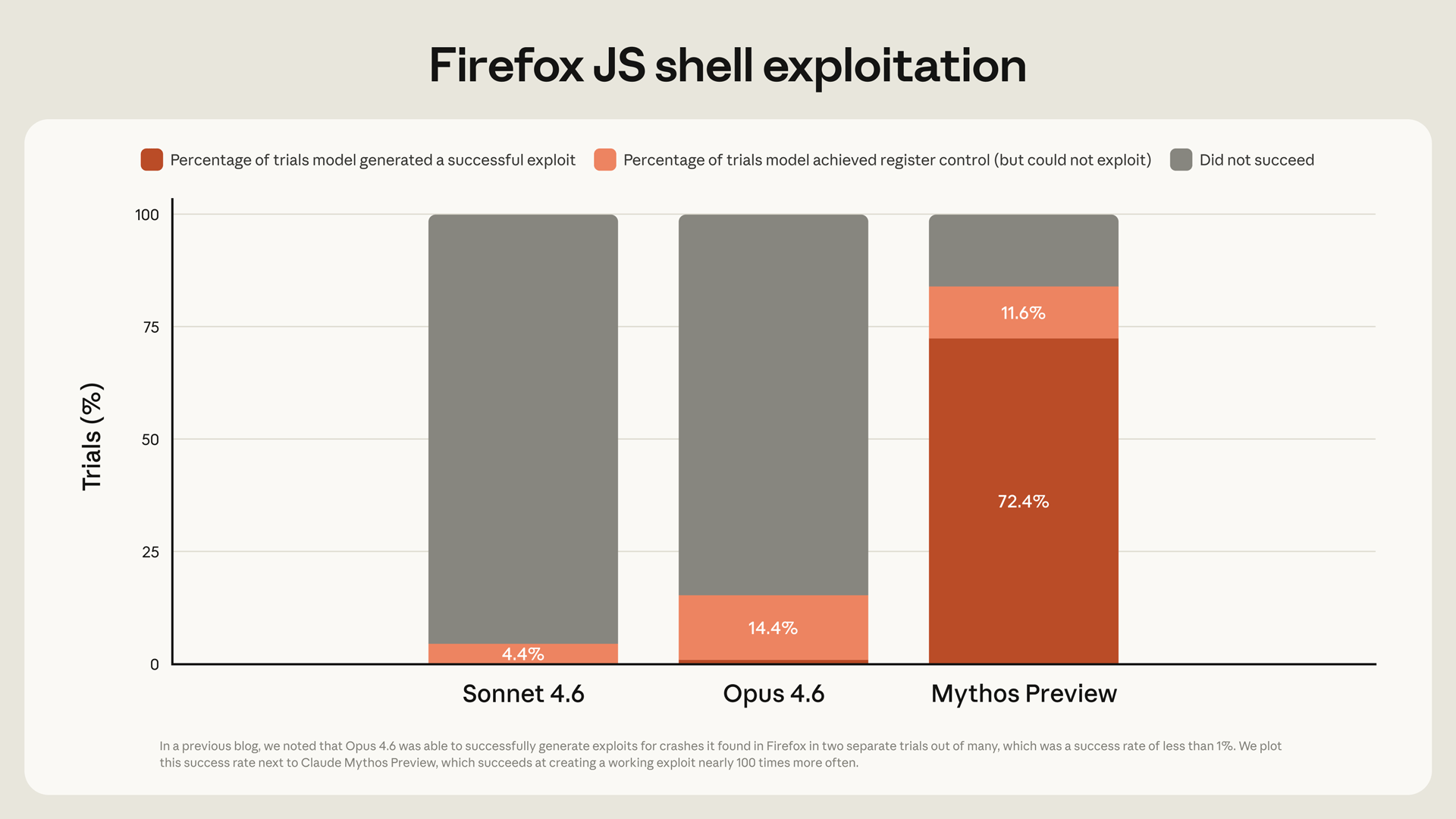
As those same researchers tell it, current versions of Claude are able to identify vulnerabilities well, but usually fail miserably at the task of turning those vulnerabilities into active exploits. Mythos, by contrast, is able to turn a whopping 72.4% of vulnerabilities it identifies into sucessful exploits within the domain of Firefox's JavaScript shell, and it is able to achieve register control in a further 11.6% of attempted attacks.
Anthropic's Frontier Red Team extensively describes the threat that an unbridled Mythos release might have on an unsuspecting software industry, and one example of its internal benchmarking practices vividly illustrates what's at stake: "We regularly run our models against roughly a thousand open source repositories from the OSS-Fuzz corpus, and grade the worst crash they can produce on a five-tier ladder of increasing severity, ranging from basic crashes (tier 1) to complete control flow hijack (tier 5).
With one run on each of roughly 7000 entry points into these repositories, Sonnet 4.6 and Opus 4.6 reached tier 1 in between 150 and 175 cases, and tier 2 about 100 times, but each achieved only a single crash at tier 3. In contrast, Mythos Preview achieved 595 crashes at tiers 1 and 2, added a handful of crashes at tiers 3 and 4, and achieved full control flow hijack on ten separate, fully patched targets (tier 5)."
Anthropic also provides several real-world examples of the kinds of bugs that Mythos has exposed, including a 27-year-old vulnerability in the famously hardened OpenBSD operating system that would have allowed an attacker to crash a system simply by connecting to it, a 16-year-old vulnerability in the foundational FFmpeg library that Anthropic says was "hit five million times by automated testing tools without ever catching the problem," and another exploit chain in the Linux kernel that would allow an attacker to achieve root access to the host system.
WIth a tool so capable of identifying exploits, Anthropic says that it is conducting responsible disclosure of the vulnerabilities it finds, but due to the volume of issues being discovered, the lab says that fewer than 1% of the potential bugs it's uncovered have been fully patched.
Going forward, Anthropic says it will not be making Claude Mythos Preview available for general use, and is instead characterizing much of its behavior through the model's system card. In the longer term, the lab hopes that by making Mythos available to a restricted subset of partners now, it can help lay the groundwork to help those companies and institutions prepare for a world where models of this class do become commonplace.
In any case, it's clear that the growth in capability of frontier AI models isn't slowing down within certa in domains of expertise, and the potentially disruptive effects of those models on the world are just one Hugging Face repository away from wreaking havoc in the wrong hands. We can only hope that labs pursuing similar capabilities with their frontier models are as responsible as Anthropic seems to be in characterizing and mitigating those risks before they cause real-world harm.

Follow Tom's Hardware on Google News, or add us as a preferred source, to get our latest news, analysis, & reviews in your feeds.

No comments